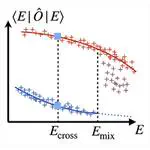
Quantum eigenstates near a thermal first-order transition split into two families with sharply different properties, or merge into macroscopic superpositions of both phases.
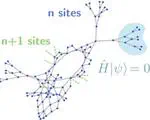
Chiral symmetry parametrically enlarges the zero-energy subspace of kinetically constrained models, and that subspace hosts interacting analogues of compact localized states.
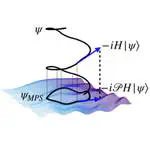
A new algorithm finds non-thermalizing quantum states by looking for the periodic orbits of a classical dynamical system.
We construct classification of dynamical quantum phase transitions using matrix product states.
We show evidence of mixed phase space in TDVP projection of unitary dynamics of interacting quantum systems.
We construct theory of unusual revivals observed in Rydberg atom arrays