Zero modes and collective bound states in constrained models
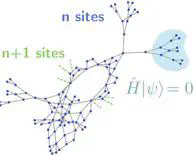
Chiral symmetry parametrically enlarges the zero-energy subspace of kinetically constrained models, and that subspace hosts interacting analogues of compact localized states.
Kinetically constrained models are a standard way to capture glassy dynamics: the system may relax slowly because simple local rules forbid many moves. Quantum versions of these models are now within reach in simulators, but it remains unclear which features are unique to their quantum nature, i.e., those that rely on quantum interference and not just on constrained dynamics. A special ingredient, present in many constrained models, is families of exactly degenerate eigenstates at zero energy, denoted as zero modes, but a unified understanding of these subspaces and their structure is missing.
We study a class of constrained quantum models where a degenerate zero-mode subspace is related to chiral symmetry. We identify a specific mechanism of how the interplay of chirality and constraints leads to a parametric enhancement of the number of zero modes. Within this enlarged subspace, we also build interacting many-body versions of compact localized states, states that stay confined to a small Fock space region because interference cancels every route for them to spread. We demonstrate these collective bound states in both one- and two-dimensional settings, and connect them to quantum fragmentation, where the system’s dynamics splits into many disconnected sectors that are not apparent from dynamical rules.
Our work invites further study of collective bound states, their quench responses, and their stability to deformations of the studied models. Moreover, it remains to be understood if these collective bound states can be related to ergodicity breaking, transport, and other properties of kinetically constrained models.
The paper, by Eloi Nicolau, Marko Ljubotina and Maksym Serbyn, is published in PRX Quantum 7 (2026).
Maksym Serbyn
Professor of Physics
My research is focused on nonequilibrium quantum systems and condensed matter physics.