Eigenstate thermalization breaks down at first-order phase transitions
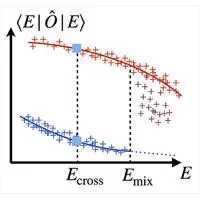
Quantum eigenstates near a thermal first-order transition split into two families with sharply different properties, or merge into macroscopic superpositions of both phases.
How does an isolated quantum system, undisturbed by any outside environment, reach thermal equilibrium on its own? The standard explanation, called the eigenstate thermalization hypothesis, assumes that every quantum eigenstate looks like the thermal state with the same energy. We show that this assumption breaks down when the system undergoes a thermal first-order phase transition, the abrupt kind of change seen when water boils. Using a model of many interacting spins, we find, as supported by analytical calculations and numerical simulations, that quantum eigenstates near the transition split into two families with sharply different properties, or merge into Schrödinger-cat states that are macroscopic superpositions of both phases at once. We propose a generalized hypothesis that captures both behaviors, and suggest signatures of such eigenstates in dynamics. Because such phase transitions are common, our results suggest that many quantum systems available in modern quantum simulators may realize this behavior.
The paper, by Maksym Serbyn, Alexander Avdoshkin, Oriana K. Diessel and David A. Huse, is published as Phys. Rev. X 16, 031042 (2026) and is available as arXiv:2601.08347.

Maksym Serbyn
Professor of Physics
My research is focused on nonequilibrium quantum systems and condensed matter physics.